Portrait of Christian Pipal
Fig. 0. The author.

Senior Research and Teaching Associate

Christian Pipal

Department of Communication and Media Research (IKMZ), University of Zurich

I am a Senior Research and Teaching Associate at the Department of Communication and Media Research (IKMZ) at the University of Zurich. My research asks how political communication changes when platforms, influencers and AI reshape who speaks to the public, and how.

Substantively, I study political social media influencers and other non-traditional political communicators, the emotional tone and style of political elites, and how AI enters political debate. Methodologically, I develop and validate computational tools for communication research, most recently large language models for content analysis, and I write about how our discipline produces evidence.

I hold a PhD in Political Science from the University of Amsterdam (2024) and have been a visiting researcher at LMU Munich and the University of Vienna.

§1Research, plotted

  • substantive
  • methodological
  • meta-science
  • article
  • chapter
  • preprint
  • data / software
Fig. 1. Every paper by year and research line. Papers that span several lines are connected vertically. Select a point to open its abstract and key figure.

§2Three research lines

§3Selected recent work

2026

Learning to Be Political: Audience Reinforcement and the Disproportionate Political Role of Smaller Social Media Influencers

Pipal, C., Wack, M., Vogel, E.-M. & Esser, F.

★ ICA Top Paper Award 2026 Substantive Preprint
Abstract & key figure

Some social media influencers (SMIs) occasionally discuss political actors and events, while others regularly engage with political topics. We ask here whether audience response helps explain this difference. We argue that engagement with political posts provides feedback that can reinforce further political posting and, over time, a move toward formal-political content. We test this argument using 761,102 Instagram posts from 1,683 Austrian and German SMIs collected over 60 months (2021–2025), combining a validated two-stage text classification pipeline with within-creator fixed-effects regressions and Cox proportional-hazards models. Political posts receive 18% more likes and 28% more comments than non-political posts by the same creator, although this boost is not larger for smaller creators. A better-performing first political post is followed sooner by another political post. Stronger engagement with lifestyle-political posts also predicts an earlier move into formal-political content, with implications for democracy given the increasing prominence of SMIs as agenda-setters in digital ecosystems. Smaller creators post political content at higher rates. Audience response therefore helps explain why political communication by SMIs persists and how it can move toward formal politics.

Key figure: Audience engagement and the dynamics of political posting (H4): better relative performance of a creator's first political post predicts a sooner next political post (a), and stronger engagement with lifestyle-political posts predicts a sooner first formal-political post (b); hazard ratios plus Kaplan–Meier curves by performance quartile.
Audience engagement and the dynamics of political posting (H4): better relative performance of a creator’s first political post predicts a sooner next political post (a), and stronger engagement with lifestyle-political posts predicts a sooner first formal-political post (b); hazard ratios plus Kaplan–Meier curves by performance quartile.
2026

Researchers Waste 80% of LLM Annotation Costs by Classifying One Text at a Time

Pipal, C., Vogel, E.-M., Wack, M. & Esser, F.

Methodological Preprint
Abstract & key figure

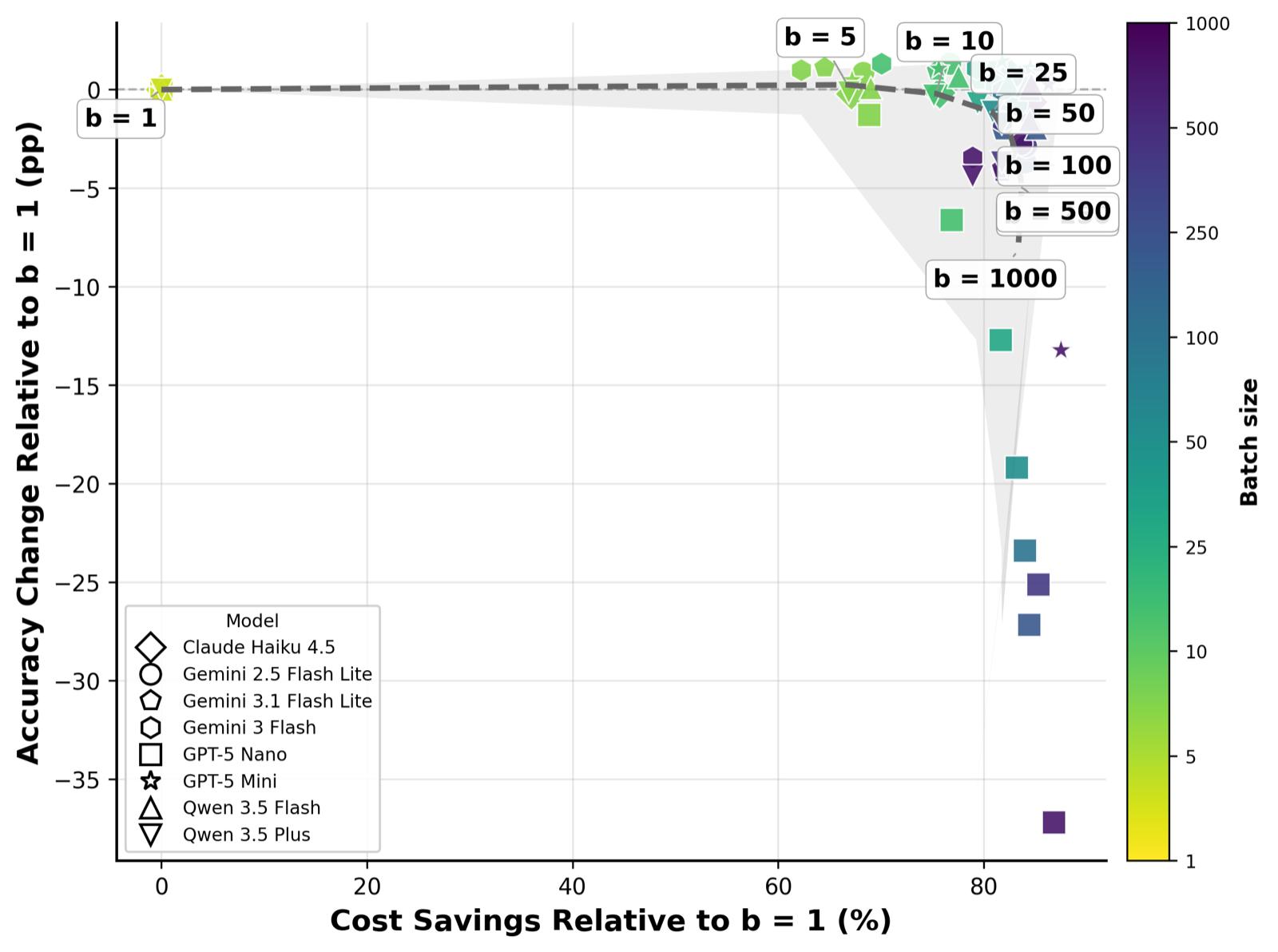
Large language models (LLMs) are increasingly being used for text classification across the social sciences, yet researchers overwhelmingly classify one text per variable per prompt. Coding 100,000 texts on four variables requires 400,000 API calls. Batching 25 items and stacking all variables into a single prompt reduces this to 4,000 calls, cutting token costs by over 80%. Whether this degrades coding quality is unknown. We tested eight production LLMs from four providers on 3,962 expert-coded tweets across four tasks, varying batch size from 1 to 1,000 items and stacking up to 25 coding dimensions per prompt. Six of eight models maintained accuracy within 2 pp of the single-item baseline through batch sizes of 100. Variable stacking with up to 10 dimensions produced results comparable to single-variable coding, with degradation driven by task complexity rather than prompt length. Within this safe operating range, the measurement error from batching and stacking is smaller than typical inter-coder disagreement in the ground-truth data.

Key figure: Cost savings versus accuracy change relative to b=1 for each model and batch size; the shaded region marks the safe operating zone, and batch-size labels show where larger batches push models along the cost–accuracy frontier.
Cost savings versus accuracy change relative to b=1 for each model and batch size; the shaded region marks the safe operating zone, and batch-size labels show where larger batches push models along the cost–accuracy frontier.
2026

Nice Try, ChatGPT: AI Accusations Target Opponents and Divert Political Debates

Wack, M., Pipal, C. & Vogel, E.-M.

Substantive Preprint
Abstract & key figure

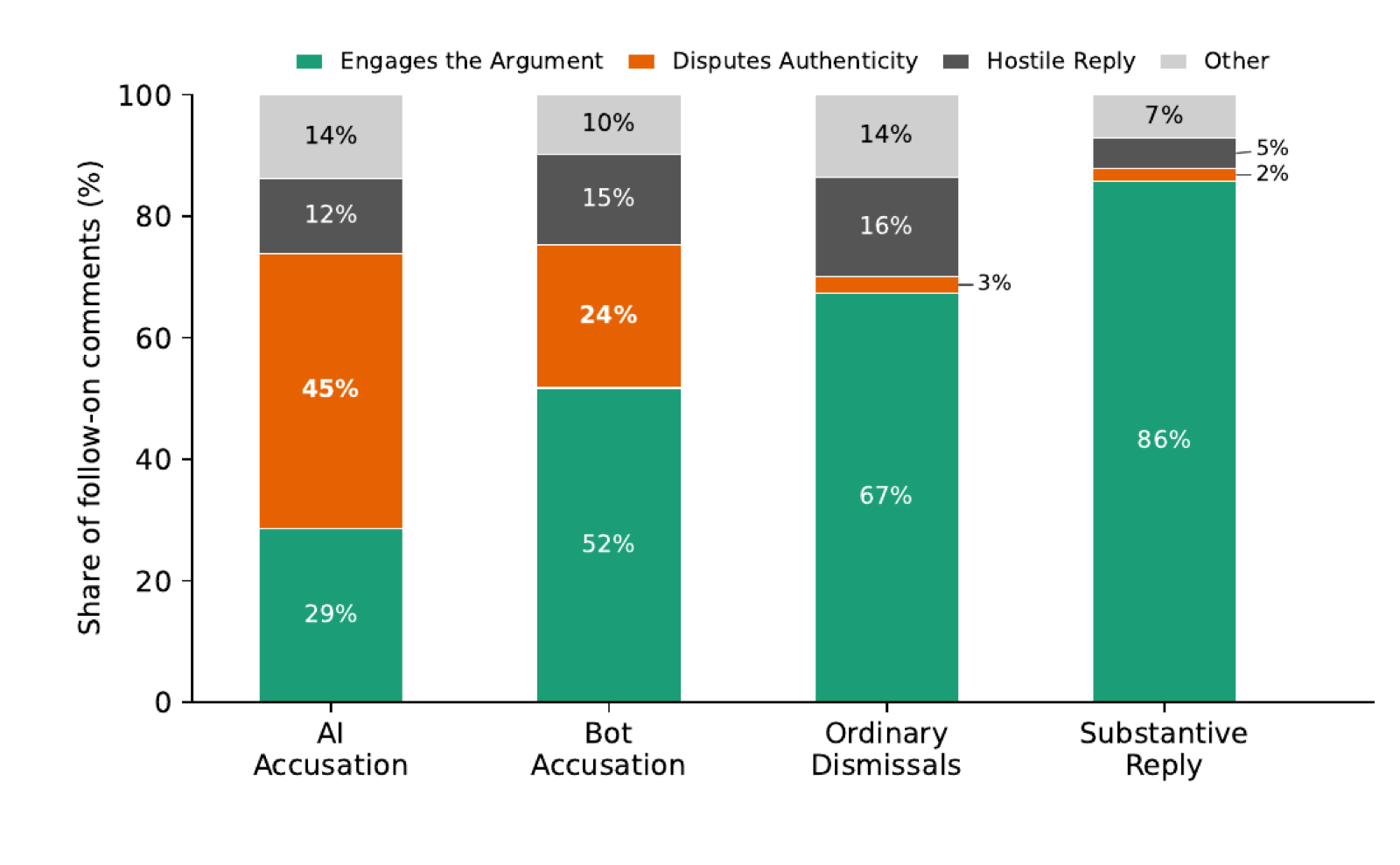
It is becoming increasingly common to encounter AI-generated text online. Yet at the same time it is often difficult to distinguish authentic text from generative outputs, particularly within shorter posts. Given this conflict, we expect accusations that a text was AI-generated to become a common strategy for deflecting unwelcome arguments. To study the occurrence of these accusations and their impact on online discourse, we draw on posts collected across two years and twelve political Reddit communities to track who is accused, whether accused comments are flagged by detection tools as AI more often, and whether these accusations disproportionately disrupt debates. Consistent with research on motivated reasoning, accusers from across the political spectrum targeted comments which opposed their views at higher rates, 72% of the time against 50% for comparable same-thread comments. AI accusations also disproportionately undermined open debate. Compared to other types of hostile dismissals, we find that substantive engagement falls to 29% (from 67%), with threads often turning to the litigation of a post’s authenticity rather than engaging with its substance. These findings illustrate the growing tendency to indict political opponents as inauthentic, which we call the motivated attribution of inauthenticity, while illustrating how the existence of generative AI can harm political conversations through suspicion alone.

Key figure: What the conversation is about after each kind of reply: follow-on comments dispute authenticity 45% of the time after an AI accusation and 24% after a bot accusation, versus 3% after ordinary dismissals and 2% after a substantive reply, while substantive engagement drops to 29%.
What the conversation is about after each kind of reply: follow-on comments dispute authenticity 45% of the time after an AI accusation and 24% after a bot accusation, versus 3% after ordinary dismissals and 2% after a substantive reply, while substantive engagement drops to 29%.
2026

When Does Self-Correction Work for LLMs in Content Analysis? The Role of External Structure and Task Complexity

Pipal, C., Wack, M., Profos, A., Vogel, E.-M., Wittstock, N. & Mpadanes, M.

Computational Communication Research, 8(2), 1–35

Methodological DOI
Abstract & key figure

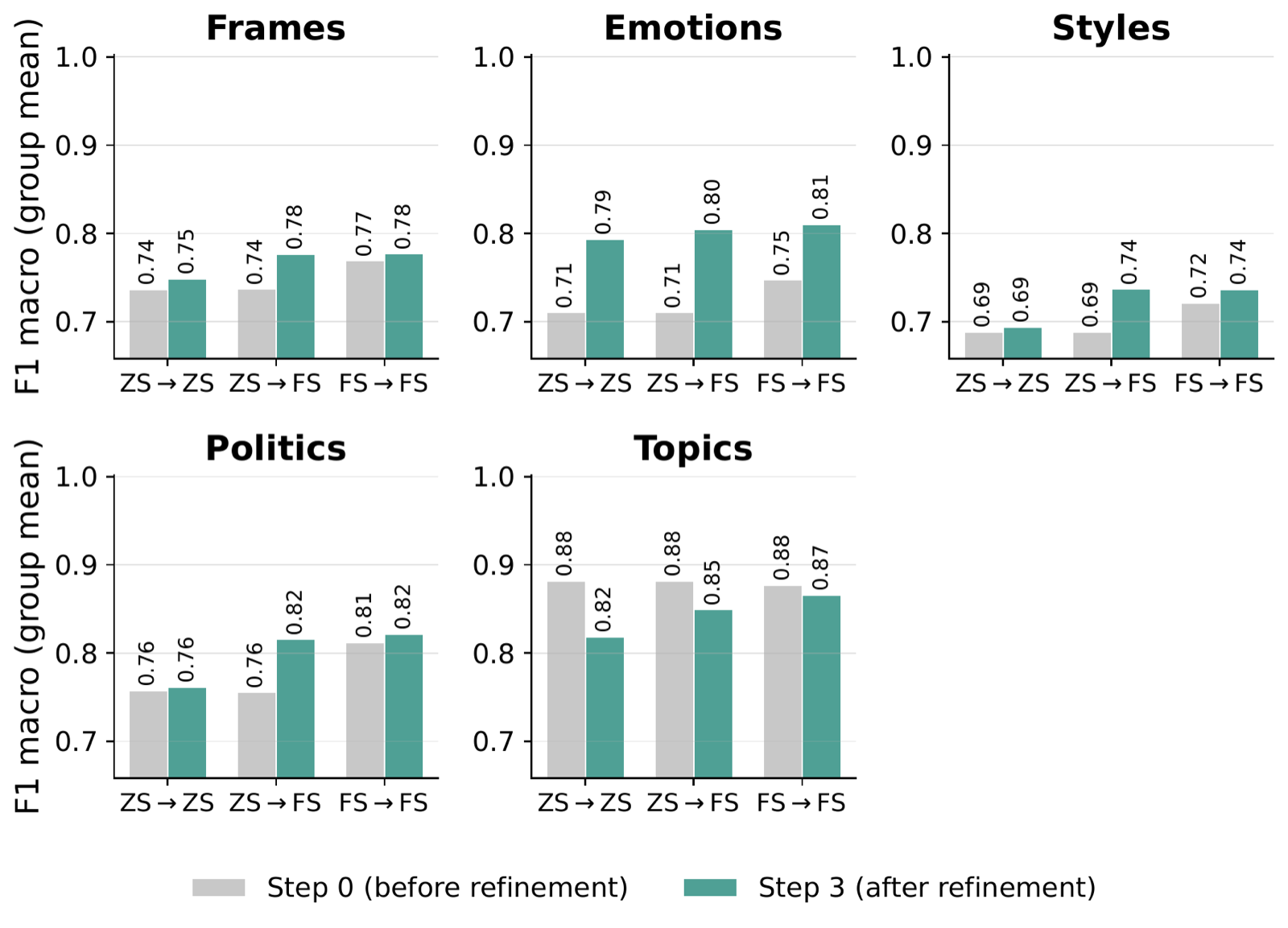
While Large Language Models (LLMs) have transformed content analysis, their ability to self-correct to achieve higher agreement with human coders remains contested. Recent evidence suggests LLMs fail to self-correct on reasoning tasks, but it is unclear if this limitation applies to classification, where the goal is maximizing overlap with human ground truth. We investigate iterative self-refinement, a pipeline where a model generates an initial classification, critiques its own output, and generates a final refined prediction. We test this across 14 variables (spanning framing, emotions, styles, politics, and topics) using a smaller, cost-effective model (Gemini 2 Flash) by systematically isolating the effects of codebooks versus few-shot examples. Results demonstrate a clear trade-off: refinement significantly boosts human alignment for complex, low-baseline constructs but degrades performance on simple, high-baseline tasks. Notably, a smaller model using refinement matches the accuracy of state-of-the-art reasoning models (Gemini 3 Flash) on complex tasks at a lower cost. These findings establish boundary conditions for self-correction, showing that external structure and task complexity jointly determine when refinement improves data quality.

Key figure: F1-macro before (S0, gray) and after (S3, green) refinement for each condition and construct type; bars show mean F1 across variables within each construct type.
F1-macro before (S0, gray) and after (S3, green) refinement for each condition and construct type; bars show mean F1 across variables within each construct type.

§4Current projects

§5News

  • Learning to Be Political received a Top Paper Award from ICA’s Political Communication Division.
  • When Does Self-Correction Work for LLMs in Content Analysis? is out in Computational Communication Research.
  • Visiting researcher at LMU Munich (CSS@LMU Fellowship).
  • Started the BAKOM-funded project Visual Tradcultures on TikTok.